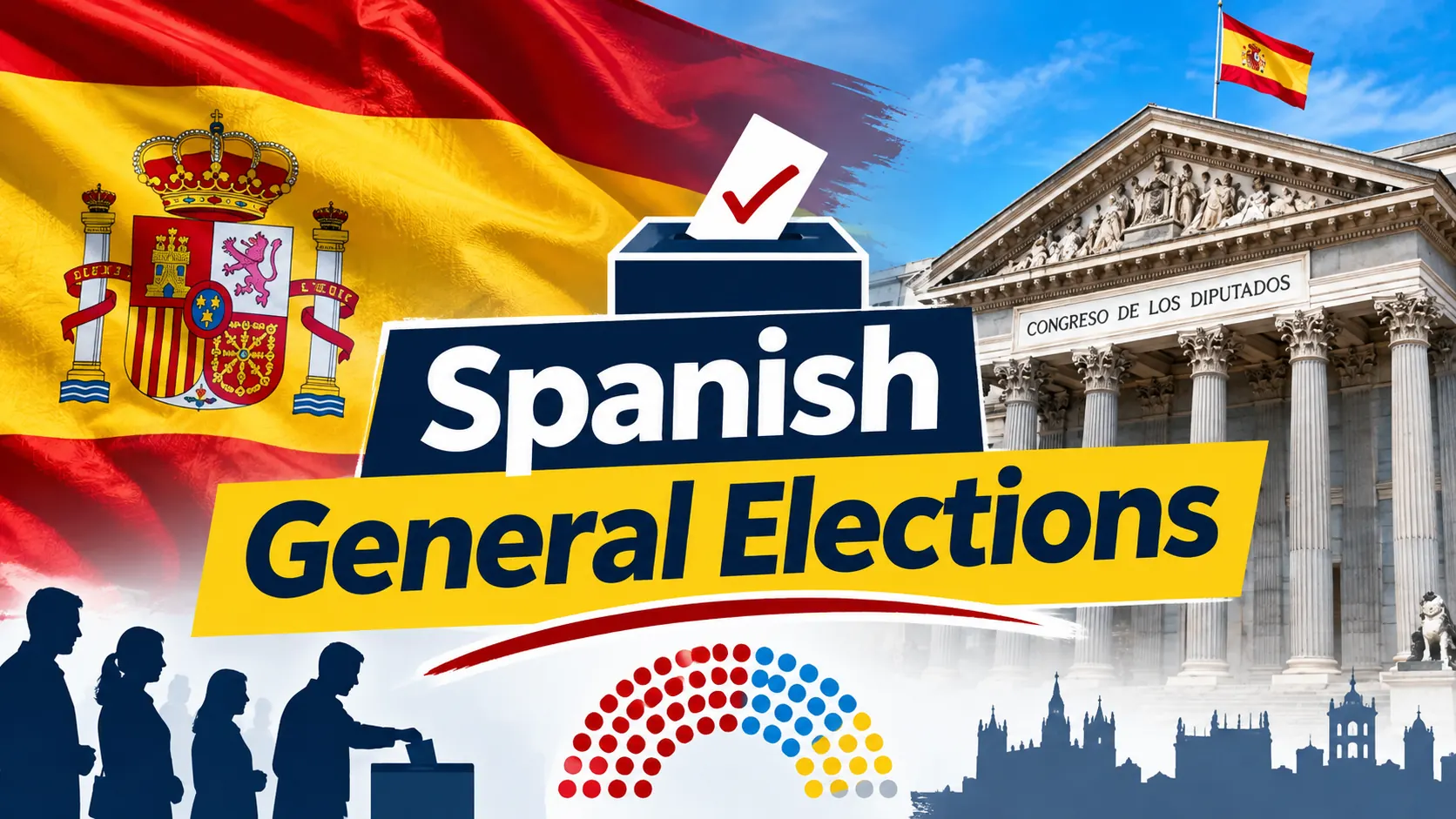

Spain General Elections 2026: Complete Guide
Spain will hold its snap general elections on Sunday, 29 November 2026, to elect representatives to the Congress of Deputies and the Senate. The election follows the dissolution of the parliament elected in July 2023 and will determine the political direction of the country for the next parliamentary term.
The election is taking place amid debates over housing affordability, the economy, public services, immigration, regional politics, government stability and the future of Spain political coalitions. Major political parties are campaigning across the country, while regional parties are expected to play an important role in parliamentary negotiations.
Spain General Election 2026: Key Details
| Election Detail | Information |
|---|---|
| Election Date | Sunday, 29 November 2026 |
| Election Type | Snap General Election |
| Parliament | Cortes Generales |
| Lower House | Congress of Deputies – 350 seats |
| Upper House | Senate |
| Eligible Voters | 38,728,356 |
| Voters Living in Spain | 35,958,711 |
| Voters Living Abroad | 2,769,645 |
| First-Time Voters | 1,615,127 |
| Campaign Period | 13–27 November 2026 |
| Reflection Day | 28 November 2026 |
| Voting Day | 29 November 2026 |
| Constitution of New Parliament | 23 December 2026 |
Why Is Spain Holding an Early General Election?
Spain was originally expected to hold its next general election later in the parliamentary cycle. However, Prime Minister Pedro Sánchez dissolved the Cortes Generales in October 2026 and called an early election.
The dissolution decree was published in the Official State Gazette on 6 October 2026. The election will allow voters to decide the composition of the next Congress of Deputies and Senate.
The political campaign is focused on government stability, housing policies, economic conditions, public services, immigration, regional autonomy and the ability of political parties to form a parliamentary majority.
Top Candidates in Spain General Elections 2026
1. Pedro Sánchez – PSOE
Pedro Sánchez is the leader of the Spanish Socialist Workers Party, known as PSOE, and the incumbent Prime Minister. He is seeking another mandate for a progressive government.
The PSOE campaign is expected to focus on economic performance, social policy, public services, employment, housing and maintaining a progressive parliamentary coalition.
2. Alberto Núñez Feijóo – Partido Popular (PP)
Alberto Núñez Feijóo leads the Partido Popular, Spain main centre-right political party. The PP is campaigning for a change of government and is seeking to secure enough parliamentary support to form the next administration.
Its campaign themes include economic policy, public administration, taxation, housing, security and government accountability.
3. Santiago Abascal – Vox
Santiago Abascal leads Vox, a right-wing national political party. The party campaigns on national unity, immigration, security, national sovereignty, taxation and changes to regional political arrangements.
Vox could become an important party in coalition negotiations if the election produces a fragmented parliament.
4. Ada Colau – Frente Amplio
Ada Colau leads the Frente Amplio electoral platform, which brings together left-wing political groups including Movimiento Sumar, Izquierda Unida, Más Madrid and Catalunya en Comú.
The platform is campaigning on housing affordability, tenant protection, social policy, public services and the organisation of the political space to the left of PSOE.
5. Irene Montero – Podemos
Irene Montero is a prominent Podemos candidate. Podemos is participating through electoral arrangements that vary by region, including alliances in some constituencies.
Its political priorities include social rights, equality policies, housing, public services and economic measures aimed at households.
Other Important Political Parties
| Party | Political Leader / Candidate | Key Political Role |
|---|---|---|
| ERC | Gabriel Rufián | Catalan republican and regional political interests |
| Junts per Catalunya | Míriam Nogueras | Catalan independence and regional interests |
| EH Bildu | Oskar Matute | Basque regional and left-wing politics |
| EAJ-PNV | Maribel Vaquero | Basque nationalist and regional interests |
| BNG | Néstor Rego | Galician nationalist politics |
| Coalición Canaria | Cristina Valido | Canary Islands regional interests |
| Compromís-Front Valencià | Àgueda Micó | Valencian regional and progressive politics |
Regional parties can play a decisive role because Spain elections are conducted across provincial constituencies and parliamentary majorities may require negotiations among several political parties.
What Is Being Elected?
Congress of Deputies
The Congress of Deputies is the lower chamber of the Spanish Parliament. It has 350 members elected through provincial constituencies.
- All 350 seats are contested.
- Provinces serve as electoral constituencies.
- Seats are allocated according to population, with minimum representation for provinces.
- Political parties generally present closed and blocked candidate lists.
- Voters select a party list rather than individual candidates.
Senate
The Senate is the upper chamber of the Cortes Generales. It represents territorial interests and includes directly elected senators and senators appointed by regional legislatures.
- Voters directly elect senators in provincial and island constituencies.
- In most mainland provinces, voters select up to four candidates.
- Island constituencies have different candidate limits.
- Ceuta and Melilla elect two senators each.
- Additional senators are appointed by autonomous community legislatures.
How Does Spain Election Voting Work?
Congress Voting
Congress elections use party lists. Voters choose the ballot paper for the political party or coalition they support. Candidate lists are closed and blocked, meaning voters cannot change the order of candidates.
Senate Voting
Senate voting is different. Voters select individual candidates from the ballot paper. The number of candidates a voter may select depends on the constituency.
Seat Allocation
Spain uses provincial constituencies and the DHondt method to allocate seats in the Congress of Deputies. The number of seats available in each province can influence how votes translate into parliamentary representation.
Who Can Vote in Spain General Elections?
Eligible voters must generally meet the following requirements:
- Be a Spanish citizen.
- Be at least 18 years old on election day.
- Be registered in the electoral census.
- Have the legal right to vote.
Voting in Spanish general elections is not compulsory. Citizens may vote in person or through an eligible postal voting procedure.
Voting Hours and Identification
Polling stations are scheduled to open at 9:00 AM on Sunday, 29 November 2026, and voting will normally close at 8:00 PM.
Voters may identify themselves using an accepted identification document, including:
- Spanish National Identity Document (DNI)
- Passport with photograph
- Driving licence with photograph
- Approved digital DNI through the MiDNI application, under the authorised procedure
Postal Voting Guide 2026
Spanish voters who cannot attend their polling station may request postal voting, subject to the official deadlines and procedures.
Postal Voting Deadlines for Residents in Spain
| Process | Deadline |
|---|---|
| Postal vote application | Until 19 November 2026 |
| Electoral documents begin arriving | From 9 November 2026 |
| Postal vote submission | By 25 November 2026 |
How to Apply for Postal Voting
- Submit a postal voting application through Correos or its authorised online service.
- Authenticate your identity where required for the online application.
- Provide the postal address where electoral documentation should be delivered.
- Receive the voting papers and electoral documentation.
- Select the appropriate ballot and place it in the voting envelope.
- Follow the official instructions and submit the postal vote through Correos.
Once an accepted postal voting application is made, the voter cannot switch to voting in person at the polling station on election day.
Voting From Abroad
Spanish citizens living permanently abroad and registered in the CERA electoral census can vote in the 2026 general election without making a separate prior request for voting documentation under the current procedure.
- Electoral documents are sent to registered voters abroad.
- Voting papers may be sent through postal procedures or obtained through the official process.
- Eligible voters can deposit ballots at designated embassies, consulates or voting centres from 21 to 26 November 2026.
- Postal voting from abroad is subject to the published deadlines and certification procedures.
Important Election Dates
| Date | Election Event |
|---|---|
| 5 October 2026 | Decision to dissolve parliament and call elections |
| 6 October 2026 | Election decree published |
| 12–19 October | Electoral census consultation period |
| 21–26 October | Candidate list submission period |
| 2 November | Polling cards begin to be sent |
| 13 November | Official campaign begins |
| 19 November | Postal voting application deadline for residents in Spain |
| 25 November | Postal vote submission deadline for residents in Spain |
| 27 November | Official campaign ends |
| 28 November | Reflection day |
| 29 November | Election Day |
| 4–7 December | Official general counting period |
| 23 December | New Parliament meets |
What Are the Main Issues in the Election?
Housing and Rent
Housing affordability, rent increases, access to affordable homes and tenant protections are major campaign issues.
Economy and Employment
Economic growth, wages, unemployment, taxes, inflation and the cost of living are important issues for voters and political parties.
Immigration
Immigration policy, border management, integration and migration-related public services remain important political debates.
Public Services
Healthcare, education, pensions, social welfare and public administration are central to the policy debate.
Regional Politics
Catalonia, the Basque Country, Galicia and other regional areas have political parties focused on regional autonomy, language, economic interests and territorial relations with the central government.
How Is the Next Prime Minister Chosen?
Spanish voters do not directly elect the Prime Minister. Voters elect members of Parliament, particularly the Congress of Deputies. After the election, the King consults political representatives and proposes a candidate for Prime Minister.
The candidate must obtain the required parliamentary support through an investiture vote. If no candidate secures the required support within the constitutional timeframe, another candidate may be proposed or a new election may eventually be called under the applicable constitutional process.
When Will Election Results Be Official?
Votes are counted at polling stations after voting ends on election night. The initial count produces provisional results. The official general scrutiny is carried out by the relevant electoral authorities during the scheduled period from 4 to 7 December 2026.
Results should be treated as provisional until the official scrutiny and proclamation procedures are completed.
Official Election Resources
- Instituto Nacional de Estadística (INE)
- Official State Gazette (BOE)
- Central Electoral Board
- Government of Spain – La Moncloa
- Ministry of Interior – Electoral Information
Frequently Asked Questions
When are Spain General Elections 2026?
The Spanish general election will be held on Sunday, 29 November 2026.
Who are the main candidates?
The main national candidates include Pedro Sánchez for PSOE, Alberto Núñez Feijóo for Partido Popular, Santiago Abascal for Vox, Ada Colau for Frente Amplio and Irene Montero for Podemos, alongside regional party candidates.
How many seats are in the Spanish Congress?
The Congress of Deputies has 350 seats.
How many people can vote?
According to the official voter statistics, 38,728,356 people are eligible to vote in the 2026 general election.
Is voting compulsory in Spain?
No. Voting in Spanish general elections is voluntary.
Can I vote by post?
Eligible voters can use postal voting by following the official application and submission deadlines.
Can Spanish citizens living abroad vote?
Yes. Eligible Spanish citizens registered in the overseas electoral census can vote through the applicable postal or consular voting procedure.
When will the new Parliament meet?
The new Cortes Generales are scheduled to meet on 23 December 2026.
Disclaimer: Election dates, voting procedures and candidate information are based on official information available at the time of publication. Readers should verify the latest updates through official Spanish electoral authorities before making voting arrangements.